Monday, January 30, 2006
Cindy Sheehan May Challenge Calif. Senator


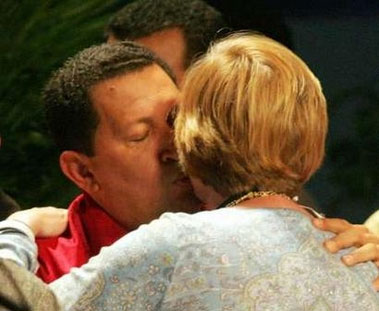
Cindy Sheehan : Who do you think you are kissing?
By Miguel Octavio
I really could care less if Cindy Sheehan is fighting the war or is agaisnt Bush, but it seems naive, disingenous and silly to come to Venezuela to speak against "militarism" at the World Social Forum, in a country run by an autocratic former military officer, coup plotter, who has over half his Government run by former or active military officers (also see here, here and here) and is spending billions in weapons, while claiming to be fighting poverty. I mean, who does she think she is kissing?
The enemy of your enemy is not necessarily your friend.

Gabriel García Márquez. El Clero en la lucha.
El 1° de mayo del año pasado -fiesta del trabajo- los curas párrocos de Venezuela leyeron en los púlpitos una carta pastoral del arzobispo de Caracas, Monseñor Rafael Arias. En ella se analizaba la situación obrera del país, se planteaban francamente los problemas de la clase trabajadora y se evocaba en sus términos esenciales la doctrina social de la Iglesia. Desde Caracas hasta Puerto Páez, en el Apure; desde las solemnes naves de la catedral metropolitana hasta la destartalada iglesita de Mauroa, en el territorio federal amazónico, la voz de la Iglesia -una voz que tiene 20 siglos- sacudió la conciencia nacional y encendió la primera chispa de la subversión. Monseñor Rafael Arias, un hombre macizo y apacible que habla con la misma sencillez y la misma cadencia criolla de cualquier venezolano corriente, había meditado mucho antes de escribir la primera línea de aquella pastoral.
La idea nació del conocimiento general que tenía el arzobispo de la realidad del país, por apreciación directa y por las conversaciones con sus párrocos. En un estudio económico de las Naciones Unidas, que recibió por correo, se enteró de que la producción per cápita de Venezuela había subido al índice de 500 dólares, pero que esa riqueza no se distribuía de manera que llegara a todos los venezolanos. "Una inmensa masa de nuestro pueblo -observó en una de sus primeras notas- está viviendo en condiciones que no se pueden calificar de humanas". Poco antes, el cardenal Caggiano, legado pontificio al II Congreso Eucarístico Bolivariano, había planteado ese problema en la sesión extraordinaria que celebró en su honor el Concejo del Distrito Federal. "Venezuela -dijo en esa ocasión Caggiano- tiene tanta riqueza que podría enriquecer a todos, sin que haya miseria y pobreza, porque hay dinero para que no haya miseria". No había una fecha prevista para la publicación de la pastoral. Monseñor Arias se había hecho el propósito de que fuera un documento breve, claro, directo e invulnerable. Al principio del año pasado ordenó a la Juventud Obrera Católica adelantar una encuesta que le permitiera formarse un juicio sereno de la realidad nacional. El sondeo duró dos meses. Con una completa documentación en el despacho, después de haber conversado no sólo con los párrocos de Caracas sino con los que vinieron expresamente de las más remotas aldeas de provincia, el arzobispo inició la redacción de sus notas, de su puño y letra. En 45 días de trabajo, de consulta con sus asesores, la primera copia definitiva -11 hojas a máquina, a doble espacio- estuvo lista en la primera semana de abril. Entonces pareció muy apropiada para su publicación la fecha del 1° de mayo, día del trabajo, fiesta del patriarca carpintero, San José.
Se precisó de una actividad extraordinaria para que la Pastoral estuviera en todas las parroquias de Venezuela en la fecha convenida. Fue dada, sellada y refrendada en Caracas a las 10:30 am del lunes 29 de abril. Dos días después se leyó en los púlpitos. A fines de la semana le había dado la vuelta al país y trascendido al exterior, donde se consideró como una brecha en el cinturón de acero creado por la censura de prensa. La primera edición -repartida gratuitamente por los párrocos- se agotó en ocho días. Algunos especuladores se hicieron de un considerable número de ejemplares y los vendieron a 10 bolívares. Una semana antes Pérez Jiménez pronunció un discurso espectacular en el Congreso, en el cual hizo una apoteósica enumeración de la obra material adelantada por su gobierno y se refirió a los elevados salarios del obrero venezolano. Ese día la Pastoral estaba hecha. Pero el ministro del Interior, Laureano Vallenilla Lanz, no entendía esa clase de argumentos. En su opinión, la pastoral del 1° de mayo era una réplica al discurso presidencial del 24 de abril.
El jueves 2 de mayo, a las 11:00 am, citó a su despacho al arzobispo de Caracas, no en una nota especial, sino por teléfono. Monseñor Arias concurrió a la convocatoria esa misma tarde y tuvo que esperar en la desierta antesala del Ministerio del Interior. Vallenilla Lanz solía recordar aquella entrevista con un orgullo evidente. "Me di el gusto -decía- de hacer esperar al arzobispo durante hora y media". En realidad, monseñor Arias -que es un hombre humilde- no esperó más de media hora. A las 3:30 pm pasó al despacho del ministro del Interior, donde se le comunicó el pensamiento oficial.
Vallenilla no iba a misa pero conocía los sermones Fue una entrevista breve, en la cual Vallenilla Lanz habló casi todo el tiempo, y casi exclusivamente de la obra material del Gobierno. Cuando monseñor Arias abandonó el despacho se le había hecho saber que el Gobierno haría publicar en los periódicos una respuesta a la pastoral. Pero esa respuesta no apareció jamás. A cambio de ella, el ministro del Trabajo dirigió al arzobispo una carta privada -con fecha 10 de mayo- que era una edición corregida y aumentada del discurso de Pérez Jiménez. El argumento más poderoso contra la carta pastoral, según el ministro del Trabajo, era la construcción de la Casa Sindical y del balneario de Los Caracas. Los párrocos de Venezuela sabían desde ese momento cuál era su deber: predicar la doctrina social de la Iglesia. Cada domingo, en los púlpitos de Caracas, se pronunciaban sermones cuyo rumor inquietaba, el lunes en la mañana, el desayuno de Vallenilla Lanz. Particularmente uno de los sacerdotes de Caracas -el padre Jesús Hernández Chapellín- asumió una posición combativa. Joven, de una salud a toda prueba y un notable valor personal, el padre Hernández Chapellín, director de La Religión, se sentaba todas las noches frente a su máquina de escribir a ejercer su doble ministerio de sacerdote y periodista. El 13 de agosto, Vallenilla Lanz -bajo el pseudónimo de R. H.- publicó en El Heraldo una interpretación atolondrada y arbitraria de la justicia social. Al día siguiente, el padre Hernández Chapellín publicó una réplica que no mandó a la censura porque sabía que la censura no la habría dejar pasar: "Orientaciones a R. H.". A las 10:00 am, una llamada telefónica del Ministerio del Interior lo despertó en su residencia particular. El propio Vallenilla Lanz estaba al teléfono. "Padre -dijo el ministro, sin preámbulos- es necesario que usted modifique su actitud". También sin preámbulos, el director de La Religión respondió: "Mis editoriales los pienso y los medito bien, luego los escribo y los lanzo y me importa poco lo que ustedes piensen de ellos". Vallenilla Lanz no respondió nada, sino que citó al padre Hernández Chapellín a su despacho, esa tarde a las 5:00 en punto. El sacerdote llegó con cinco minutos de retraso.
En hora y media, el padre Hernández se hizo conspirador La entrevista duró un poco más que la de monseñor Arias y esta vez fue el sacerdote quien habló casi todo el tiempo. Vallenilla Lanz, vestido de gris y un poco pálido, no había tenido tiempo de iniciar el diálogo, cuando el director de La Religión tomó la iniciativa. "Voy a hablar -dijo- más que todo como sacerdote que sólo teme a Dios. Con el régimen que ustedes tienen en Venezuela casi todo el pueblo los odia y los detesta". Vallenilla Lanz enrojeció: -¿Por qué?- preguntó tímidamente. -Porque ustedes tienen un régimen de pánico con la Seguridad Nacional. Es la espada de Damocles sobre la cabeza de cada venezolano. Las lágrimas y la sangre y la cantidad de muertos... -¿Cuáles muertos?- interrumpió Vallenilla Lanz, con un aire de cándida inocencia. El padre Hernández Chapellín enumeró, con sus nombres propios, 10 víctimas del régimen. "Y los que no sabemos", agregó. "¿Y los exilados políticos?" Vallenilla Lanz empezó a reaccionar. -Usted llama exilados políticos a bandidos como Rómulo Betancourt, dijo. -Betancourt y yo -replicó el padre Hernández Chapellín- estamos en trincheras opuestas, como otros muchos exilados. Pero ellos también son venezolanos y aquí deben estar para que les demos la pelea en el terreno ideológico. Los dos hombres estaban solos en el despacho. El sacerdote, con ese entusiasmo un poco estudiantil con que habla con sus amigos en la redacción de su periódico, siguió enumerando las razones por las cuales el régimen de Pérez Jiménez era una maquinaria de terror. Dijo: "Si cuando el general se tomó el poder hubiera hecho elecciones libres en vez de proseguir y de trancarle la voz a la prensa, se hubiera inmortalizado. Pero la realidad es otra. Se quedó en el poder por un golpe de estado al derecho de sufragio". El padre Hernández Chapellín abandonó el despacho a las 6:30 pm, cuando ya habían salido los empleados del ministerio. Con un cinismo inconmovible, Vallenilla Lanz lo acompañó hasta la puerta, lo despidió con un abrazo y le dijo: "Las puertas de mi despacho estarán siempre abiertas para usted". Pero el padre Hernández no volvió a franquearlas. Siguió librando la batalla desde su modesta oficina de periodista. Pocas semanas más tarde, su robusto y combativo colega, Fabricio Ojeda, se presentó en la redacción de La Religión. -Padre -dijo Fabricio Ojeda- vengo a decirle una cosa como si fuera una confesión: yo soy el presidente de la Junta Patriótica. A partir de ese día, el padre Hernández Chapellín no fue solamente un sacerdote dispuesto a sacar adelante la doctrina social de la Iglesia ni solamente un periodista de la oposición. Fue también un conspirador.
Lluvia de volantes en la Catedral. Estrada acechaba En su plácido despacho de la catedral metropolitana, de espaldas a un estante atiborrado de libros que cubre toda una pared, el padre José Sarratud recibió el 11 de julio, a las 2:00 pm, una llamada telefónica del Ministerio de Justicia. El padre Sarratud, que es muy joven pero que parece más joven de lo que es, no tenía motivos para conocer la voz del ministro: era la primera vez que la escuchaba. En pocas palabras, el ministro le dijo: "Padre, usted está atacando al Gobierno en sus sermones". El padre Sarratud, sin levantar la voz, sin el menor indicio de alteración, respondió: "No hago otra cosa que predicar la doctrina social de la Iglesia". Durante un mes entero, no modificó el tono de sus sermones. En septiembre volvió a llamarlo el ministro de Justicia, y el padre Sarratud volvió a responder: "Señor ministro, no hago otra cosa que predicar la doctrina social de la Iglesia". Poco tiempo después, un incidente habría de llevar el nombre del padre José Sarratud hasta el sombrío despacho de Pedro Estrada. Ocurrió el 12 de diciembre: durante una manifestación de mujeres, a un costado de la Catedral, un hombre gritó: "Abajo Pérez Jiménez". Tratando de alcanzarlo, un policía se abrió paso entre las mujeres y agredió a una de ellas, encinta. Seis hombres atacaron al agente. De pronto, sin que nadie hubiera sabido en qué momento, millares de volantes contra el Gobierno cayeron sobre la multitud. Habían sido lanzados desde la torre de la Catedral.
Pedro Estrada hizo averiguaciones y descubrió que aquellos volantes habían sido impresos en el multígrafo de la Catedral, puesto al cuidado del padre Sarratud. El director de la Seguridad Nacional esperó un momento propicio para actuar. Ese momento propicio se presentó el 1° de enero, a raíz del levantamiento de Maracay. Desde cuando volaron los primeros aviones sobre Caracas, Estrada se asiló en la Embajada de Santo Domingo. Pero al día siguiente, cuando supo que el golpe había fracasado, se instaló en su despacho de la avenida México, a dirigir personalmente las represalias. El 3 de enero, el arzobispo le dijo por teléfono al padre Sarratud que Pedro Estrada lo estaba buscando desde hacía tres días. El sacerdote, que no se había escondido, se echó al bolsillo el breviario y se dirigió en automóvil a la SN. Lo recibió Miguel Sanz, quien sin formular juicio lo mandó a la celda. En el cuarto piso de la Seguridad Nacional se llevó una sorpresa: allí había, detenidos, cuatro sacerdotes más. Se les acusaba de que sus sermones eran la causa moral del levantamiento militar.
Cinco sacerdotes presos: El Gobierno se cae a pedazos Al padre Alfredo Osiglia lo fueron a buscar cuatro detectives armados, en la mañana del 2 de enero, hasta la iglesia de la Candelaria, donde acababa de decir la misa. A las 3:00 pm, monseñor Delfín Moncada, después de almorzar en su casa de Los Chaguaramos, llegó en su modesto automóvil negro al despacho parroquial de Chacao, y allí lo esperaba un hombre de apariencia humilde. Era un enviado de Pedro Estrada. Monseñor Moncada se comunicó con el arzobispo por teléfono y se dirigió, solo, a la Seguridad Nacional. Lo condujeron al despacho de Sanz. Sentado en un rústico banco de madera, ese sacerdote sólido y sanguíneo, pero de edad avanzada, esperó al segundo de Pedro Estrada durante siete horas, minuto a minuto. Había ido con el propósito de dejar una constancia, pero dos guardias armados de ametralladoras le comunicaron que estaba detenido. Al atardecer, monseñor Moncada pidió permiso para ir al baño. Los guardias lo acompañaron, encañonándolo, y no le permitieron cerrar la puerta. A las 11:00 pm, rodeado de sus guardaespaldas, entró Miguel Sanz. "Usted -dijo, dirigiéndose a Monseñor Moncada- encabeza la lista de cinco sacerdotes que son los autores morales del cuartelazo de Maracay". Luego, sin solución de continuidad, agregó: -Además, usted se ha mostrado desatento con el Presidente. -En los afectos no se mete ni Dios, respondió Monseñor Moncada. -Vaya a predicar eso allá arriba, replicó el negro Sanz. Allá arriba, en el cuarto piso, estaba desde el mediodía el padre Jesús Hernández Chapellín, el único de los cinco sacerdotes que fue sentenciado personalmente por Pedro Estrada. Para el director de La Religión, la Seguridad Nacional destacó ocho detectives: cuatro en su oficina y cuatro en su casa. El padre Hernández Chapellín, que no quiso presentarse a la seguridad antes de hablar con el Arzobispo, eludió los sitios habituales y almorzó en casa de unos parientes suyos, en el Cementerio. De allí se comunicó por teléfono con monseñor Arias, quien envió a un sacerdote para que lo acompañara hasta la avenida México. A las 2:00 pm, impecablemente vestido de azul claro y con corbata blanca, Pedro Estrada lo hizo pasar a su despacho. -Padre -le dijo- usted está complicado en el golpe militar de ayer. Ese es el resultado de sus editoriales que son incendiarios, revolucionarios, y que no parecen de un ministro de Dios. Pedro Estrada no levantó los ojos en ningún momento de la entrevista. Hablaba con la cabeza inclinada, eludiendo sistemáticamente la mirada segura del padre Hernández Chapellín. -No refuto lo de Maracay -respondió el director de La Religión- porque me parece infantil. En cuanto a mis editoriales, le diré que me tiene sin cuidado lo que ustedes piensen y no es mi culpa si ustedes se ven retratados en ellos. -¿Usted no está de acuerdo con el régimen?- preguntó Pedro Estrada. -No. Estoy en completo desacuerdo. Estrada no se atrevió a hacerse responsable de su detención. Dijo que tenía órdenes superiores. El padre Hernández Chapellín fue conducido al pabellón destinado a los cinco sacerdotes. Sólo uno de ellos salía todas las noches a dormir a su casa, el padre Pablo Barnola, de la Universidad Católica. Querían que se asilara para que abandonara al país. Pero el padre Barnola no lo hizo. Sus compañeros de prisión le llamaban "el semi interno". La única visita que se les permitió fue la del doctor Guillermo Altuve Carrillo, enviado personal de Pérez Jiménez, el domingo 5 de enero. Trató de convencerlos de que modificaran su actitud en relación con el Gobierno. Pero ellos se mostraron inflexibles. El doctor Altuve Carrillo, furibundo, les lanzó una amenaza: -Sepan que no tumbarán al Gobierno. Aquella amenaza no duró mucho tiempo. El 13 de enero, el Gobierno empezó a caerse a pedazos. Pedro Estrada abandonó el país. El coronel Teófilo Velasco, quien lo reemplazó, puso en libertad a los cinco sacerdotes.
El padre Alvarez, de La Pastora, un conspirador de rueda libre La ciudad que ellos encontraron al salir de la cárcel había sufrido una transformación sensacional. Todo el mundo, desde el industrial en su gerencia hasta el vendedor ambulante en la calle, estaba conspirando. En la humilde parroquia de La Pastora, el padre Rafael María Álvarez Flegel -156 centímetros cargados de un dinamismo incontenible- estaba comprometido hasta los huesos en la conspiración. En los primeros días de enero, un sobrino suyo, Ramón Antonio Álvarez Cabrera, estudiante del colegio Carabobo, le informó confidencialmente que estaba actuando en contacto con la Junta Patriótica. Necesitaban un multígrafo. El padre Álvarez no se conformó con compartir el secreto y prestar el multígraf Que tiempos aquellos. o de la parroquia para reproducir los volantes clandestinos, sino que hizo las copias en su máquina y trabajó personalmente en la impresión. Usaba guantes para evitar las huellas digitales. Durante los primeros 15 días del año, sin ningún contacto directo con la Junta Patriótica, el padre Álvarez ocupó la jornada entera en su ejemplar trabajo de conspirador espontáneo. Los muchachos llevaban el papel en la mañana y volvían en la noche por las copias. En varias parroquias se adelantaba una actividad semejante. Apenas salido de la cárcel, el padre Sarratud entró en contacto con otros grupos estudiantiles que celebraban reuniones en una dependencia de la Catedral e imprimían allí volantes clandestinos. A medida que se acercaba el martes 21, el padre Álvarez sentía que los días le quedaban cortos. La huelga general estaba preparada, pero el efervescente párroco de La Pastora en su solitario y escueto despacho, sin otro contacto con el gigantesco mecanismo de la conspiración que su grupo de estudiantes, sentía que algo faltaba: un ultimátum a Pérez Jiménez, con condiciones concretas. En la noche del 19 redactó él mismo, por su cuenta y riesgo, el último volante, y se tomó la libertad de firmarlo: "La Junta Patriótica". No se conformó con imprimirlo, sino que puso al correo urbano en sobres cerrados una copia para Pérez Jiménez y cada uno de sus ministros. En su cuarto, debajo de la estrecha cama de hierro pintada de azul, quedaron 500 ejemplares que los muchachos irían a buscar esa noche. Los esperó hasta las 11:00 pm. Antes de acostarse dio orden al sacristán de no quitar las cuerdas de las campanas para que los huelguistas pudieran tocarlas al día siguiente, a las 12:00 en punto. Se durmió a la media noche después de escuchar los últimos boletines en la radio. A la 1:30 am varios golpes a la puerta lo despertaron sobresaltado. Una voz masculina gritó: "Padre, acompáñenos, para que bautice un niño que se está muriendo". El padre Álvarez abrió la puerta y vio al resplandor de las bombillas del patio cuatro hombres oscuros, con las manos en los bolsillos. Eran agentes de la Seguridad Nacional. Las campanas de la mayoría de las iglesias de Caracas anunciaron a las 12:00 el principio de la huelga general. La policía había destacado agentes para evitarlo, pero los sacristanes tenían órdenes terminantes de facilitar la entrada de los huelguistas. A monseñor Moncada lo visitó el prefecto de Chacao, a las 11:00 am, para advertirle que sería sancionado si tocaba las campanas. El sacerdote respondió que la policía no podía prohibir la costumbre secular de dar las 12 seguidas por un breve repique. Protegido por el pueblo, el sacristán repicó tres minutos por cuenta del párroco y tres minutos más por su propia cuenta. En la Candelaria, la policía estuvo a punto de enloquecer con unas campanas que sonaban sin campanero. El párroco había instalado a los altoparlantes una cinta magnética, que giró -repicando- durante varias horas. El párroco contempló el espectáculo desde el abasto de enfrente, vestido de civil. Al padre Alvarez le habría gustado tocar las campañas con sus propias manos. Pero a esa hora estaba detenido en el convento de los Padres Benedictinos de San José del Ávila. Los agentes de la SN habían pasado la madrugada en su dormitorio, esperando instrucciones. Uno de los estudiantes llamó por teléfono y fue un detective quien respondió: "¿A qué hora es la misa?", preguntó el estudiante. "No hay misa", respondió el detective, sin saber que aquello era una clave. Por esa respuesta supieron los muchachos que el padre Álvarez estaba en poder de la Seguridad Nacional. Acompañado por el arzobispo, el coronel Velasco se dirigió a La Pastora a las 6:00 am y se opuso a que el párroco fuera conducido a la seguridad. Desde su celda conventual, el padre Álvarez oyó las campanas, las cornetas y los pitos de las fábricas, y supo entonces que su labor no había sido útil y que antes de 48 horas estaría de nuevo en su púlpito.
En la Iglesia profanada, el párroco herido esperaba... El arzobispo se encontraba en una situación difícil: no podía intervenir directamente en política, pero tampoco podía -ni como miembro ilustre de la Iglesia ni como venezolano- impedir el trabajo subversivo de sus párrocos. Las relaciones entre Venezuela y el Vaticano habían llegado a un peligroso grado de tirantez. El nuncio apostólico había protegido en la Nunciatura al político Rafael Caldera y a un oficial del levantamiento de Maracay. Monseñor Jesús María Pellín -cuyo despacho es una biblioteca blindada de 14.000 volúmenes- había pronunciado un sermón sobre el prevaricato y se había visto precisado a abandonar discretamente el país. Como miembro, varias veces reelecto, del comité de Libertad de Prensa de la Sociedad Interamericana de Prensa (SIP) había firmado una declaración en la cual se condenaba el régimen de Pérez Jiménez por haber amordazado a la prensa. En todos los frentes la Iglesia participaba en la resistencia. Los colegios dirigidos por religiosos estuvieron entre los primeros que echaron sus alumnos a la calle para que manifestaran contra el régimen. El régimen lo sabía, pero ya en enero habría podido encarcelar a todos los sacerdotes de Venezuela sin ningún resultado. La fuerza democrática se había desencadenado. Monseñor Hortensio Carrillo, párroco de Santa Teresa, tenía informes de que la policía y la seguridad, a espaldas del coronel Velasco, tenía preparado un asalto a su templo. Sólo se esperaba una oportunidad.
Monseñor Carrillo no podía renunciar a su deber. El martes 21, un poco antes del mediodía, estaba diciendo su misa ordinaria cuando una manifestación de médicos perseguida por la policía se refugió en la iglesia. En la confusión, la misa fue interrumpida, y agentes uniformados y civiles irrumpieron en el recinto, armados de fusiles y ametralladoras. En un instante la iglesia de Santa Teresa se impregnó de gases lacrimógenos, pero los policías impidieron la salida de las 500 personas -hombres, mujeres y niños- que se asfixiaban en el interior. Una bomba estalló a pocos metros de monseñor Carrillo. Los fragmentos se le incrustaron en las piernas y el párroco, con la sotana en llamas, se arrastró hasta el altar mayor. A pesar de la confusión, un grupo de mujeres mojaron sus pañuelos en el agua bendita de la sacristía y apagaron la sotana del párroco. Cuando la iglesia fue evacuada, la policía se opuso incluso a que las ambulancias se llevaran oportunamente a los heridos. El arzobispo llamó por teléfono al comandante de la policía, Nieto Bastos, cuando todavía la iglesia estaba sitiada. Nieto Bastos respondió: Son ellos quienes están acribillando a la policía. Monseñor Carrillo no pudo ser conducido al hospital. Con las piernas inutilizadas por los fragmentos de la bomba fue llevado al despacho parroquial, hasta donde logró penetrar, al atardecer, un médico que le prestó los primeros auxilios. El sacerdote fue sentado en un escritorio frente a una puerta que da directamente sobre la calle. Una patrulla de policía hizo tres descargas contra la puerta: un tiro de fusil, otro de revólver y una ráfaga de ametralladora. La bala de fusil perforó la puerta, atravesó el despacho y se incrustó en la pared del fondo, a 20 centímetros sobre la cabeza de monseñor Carrillo. Durante toda la noche, mientras el párroco sufría en su dormitorio del primer piso, presa de terribles dolores, la policía disparó contra la iglesia para dar la impresión de que allí había grupos atrincherados. Energúmenos, subrayaban las descargas con toda clase de expresiones obscenas. Pero monseñor Carrillo, a pesar de su estado, sabía que aquel asedio no podía durar mucho tiempo. Así fue. El heroico pueblo de Caracas, con piedras y botellas, descongestionó el sector a la mañana siguiente. Horas después, el párroco experimentó una inmensa sensación de alivio. La misma sensación de alivio que experimentó Venezuela. Era la madrugada del 23 de enero. El régimen había sido derrocado.
Gabriel García Márquez
DEUS CARITAS EST: POWERFUL TEXT ON CORE OF CHRISTIAN FAITH
In his remarks, Cardinal Martino made reference to that part of the Encyclical in which the Pope considers the relationship between justice and charity, and indicates certain points concerning the field of jurisdiction of the Church and her social doctrine, and the jurisdiction of the State, in achieving a just social order.
After highlighting how the building of social and State order is not immediately incumbent upon the Church but rather upon the political sphere, the Pope points out that "the Church is duty-bound to offer, through the purification of reason and through ethical formation, her own specific contribution towards understanding the requirements of justice and achieving them politically."
The Holy Father, Cardinal Martino went on, "affirms that, in building a just social order, the duty of the Church with her social doctrine is that of reawakening spiritual and moral forces." In this context, he continued, "lay people, as citizens of the State, are called to participate directly in public life." Their mission "is to mould social life appropriately, respecting its legitimate autonomy and cooperating with other citizens, according to their respective areas of jurisdiction, each under their own responsibility."
"The presence of lay people in the social field," the cardinal continued, "is here conceived in terms of service, a sign and expression of charity which is made manifest in family, cultural, working, economic and political life."
For his part, Archbishop Levada affirmed that the Encyclical, is "a powerful text on the 'nucleus of Christian faith,' understood as the Christian image of God and the image of man that derives from it. A powerful text that seeks to counter the erroneous use of the name of God, and the ambiguity concerning the word 'love' that is so evident in the world today."
"In order to explain the novelty of Christian love, the Holy Father seeks first to illustrate the difference and unity between two concepts inherent to the phenomenon of love from the times of the ancient Greeks: 'eros' and 'agape'." These two concepts "do not oppose one another, but come harmoniously together to offer a realistic concept of human love, a love that involves the entirety - body and soul - of the human being. 'Agape' prevents 'eros' from abandoning itself to instinct, while 'eros' offers 'agape' the fundamental and vital relationships of human existence."
The prefect of the Congregation for the Doctrine of the Faith then went on to point out how "in the indissoluble marriage between man and woman this human love takes a form that is rooted in creation itself."
"Love for others, rooted in the love of God, is the duty, not only of each individual faithful, but also - and here we come to the second part of the Encyclical - of the entire community of believers, in other words the Church. From the historical development of the ecclesial aspect of love, which dates back to the very origins of the Church, we may draw two conclusions: firstly that the service of charity is part of the essence of the Church, secondly that no one must lack what they need, either within or outside the Church."
In his Encyclical the Pope, Archbishop Levada added, "offers some illuminating comments on certain aspects of the Church's service of charity - 'diakonia' - in modern times. He responds to the objection according to which charity towards the poor is an obstacle to the fair distribution of the wealth of the earth to all mankind."
At the same time the Pope "praises new forms of fruitful collaboration between State and Church bodies, making reference to the phenomenon of voluntary work."
In summing up the Encyclical, Archbishop Levada pointed out how it "offers us a vision of love for others, and of the ecclesial duty to practice charity, as being a way to implement the commandment of love, one that finds its roots in the essence of God Himself, Who is Love." The document, he concluded, "invites the Church to a renewed commitment to the service of charity ('diakonia') as an essential part of her existence and her mission."
The last to speak was Archbishop Paul Josef Cordes, who highlighted how "today's text is the first ever Encyclical on the subject of charity." Perhaps, he suggested, the presentation had also been entrusted to him as president of "Cor Unum" because his dicastery "puts into effect the Pope's personal initiatives as a sign of his compassion in the face of certain situations of misery."
"The Church's charity is made up of concrete initiatives," said the archbishop. "It includes political initiatives, such as those for the elimination of debt of the poorest countries. We wish to promote an awareness of justice in society." However, he went on, "Pope Benedict XVI [also] wished to illuminate charitable commitment with a theological foundation. ... He is convinced that faith has consequences on the individual who acts, and therefore on the manner and intensity of his acts of charity."
"The social doctrine of the Church and the theology of charity are, without doubt, inter-linked," the prelate said, "but they are not exactly the same. Indeed, the former expresses ethical principles associated with the search for the common good and moves, therefore, more at a political and community level. On the other hand, caring - both individually and together - for the suffering of others does not call for a systematic doctrine. Rather, it arises from the word of faith."
"In our society there exists, fortunately, a widespread feeling of philanthropy, ... but this can give the faithful the idea that charity is not an essential part of the ecclesial mission. Without a solid theological foundation, the great ecclesial agencies could become ... disassociated from the Church, [and] ... prefer to identify themselves as non-governmental organizations. In such cases, their 'philosophy' and their projects would be indistinguishable from the Red Cross and the U.N. agencies. This, however, contrasts with the two-thousand-year history of the Church, and does not take into account the intimate rapport between ecclesial action on behalf of man and credibility in the announcement of the Gospel."
"We must go further," Archbishop Cordes concluded, "the present sensibility of so many people, especially the young, also contains a 'kairos apostolico.' This opens notable pastoral prospects. There are innumerable volunteers, and many of them discover the love of God in the giving of themselves to others with disinterested love."
ENC/DEUS CARITAS EST/...
Taken from the Vatican Information Service
To read the full text of the Encyclical, click here
Friday, January 27, 2006
Dear America,
My suggestion is that you should take care of your borders ASAP, otherwise there's a BIG chance we we won't be around to tell the end of days,
Sincerely,
Feathers
Wednesday, January 25, 2006
Understanding and classifying the PSF
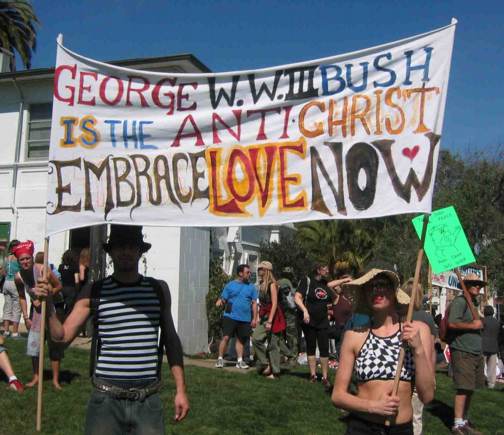
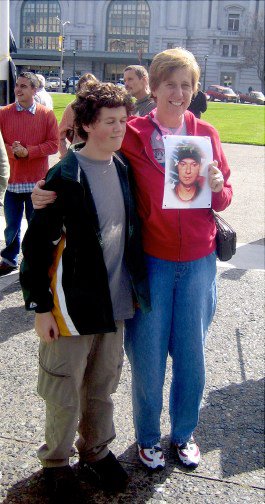
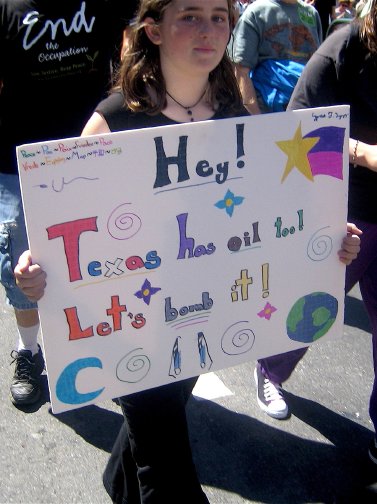
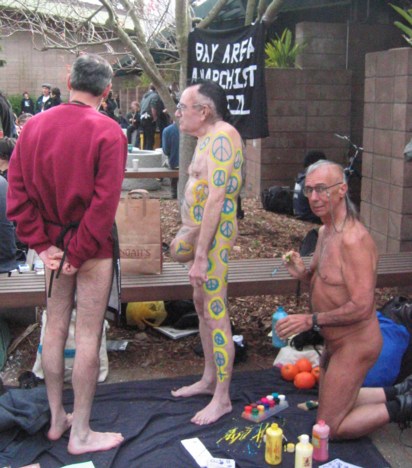
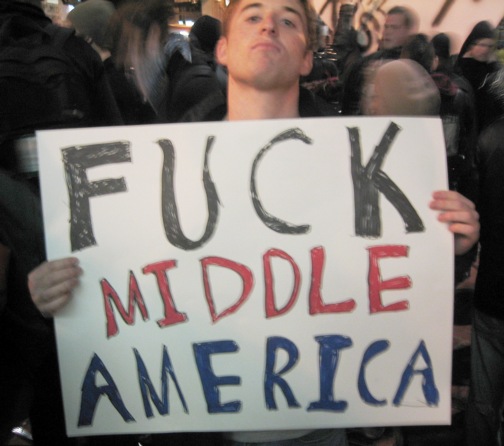
PSF (Pendejos sans frontier) as many of you know, come in various shapes and forms. Many are very smart, educated, normal people with a lot of noble ideals to the world, and a serious case of Bush hate. Others... well... others come from San Francisco! (pictures courtesy of www.zombietime.com)

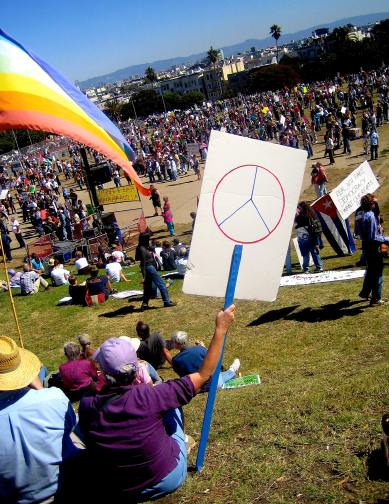
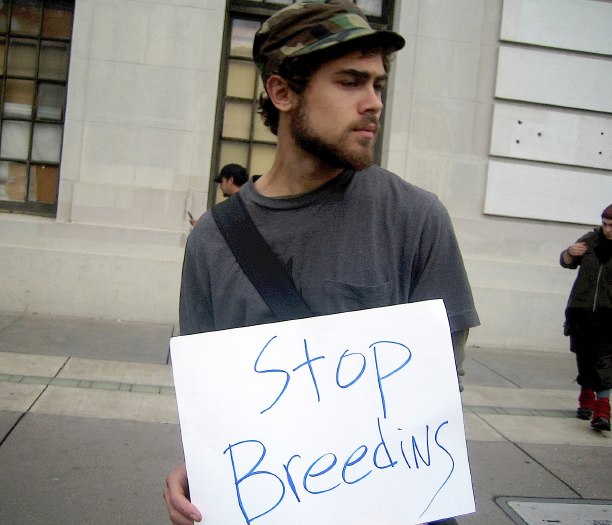
Ehh?

Tuesday, January 24, 2006
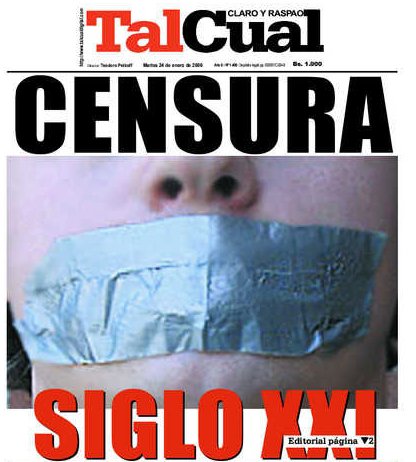
Reporter sans frontiers about the censorship of the media regarding the Danilo Anderson case
Click on the title to link to the news.
Also, see editorial of Teodoro Petkoff's Tal Cual (en español). In english, click here.
A new wrinkle for globalization
International Herald Tribune
Jan 24, 2006
Russian muscle-flexing over natural gas supplies, a left turn in Latin American politics, the growing industrial might of Asia and protectionist noises in the U.S. Congress and continental Europe: Economic nationalism in various guises is on the rise across the world. And this could have cascading implications for politics, economics and business in the years to come, according to officials, economists and executives heading for the World Economic Forum in Davos this week. "The resistance to globalization has a new quality today," said Joseph Nye, a professor of international relations at Harvard. "You have populist leaders in developing countries who are empowered by high oil prices and you have a protectionist climate in the rich countries. The two trends reinforce each other and could slow globalization." Certainly protectionist tendencies and economic nationalism are not new. In the 1970s, the Organization of Petroleum Exporting Countries withheld energy for political ends. In the 1980s, the emergence of Japan on the economic world stage prompted large U.S. companies to demand a series of measures aimed at Japanese imports. But what is novel about today's climate is that both types of nationalism are gaining currency at the same time and in a broader number of countries, analysts say. The backdrop is a fundamental shift in power in the world as a number of midsize nations emerge to rival the political and economic dominance of the West - and as a global race for energy resources increasingly determines influence. An oil price that has flirted with $70 a barrel and soaring prices of other fuels has transferred economic clout to resource-rich countries. Russia sent shock waves across Western Europe and beyond when Gazprom briefly cut the supply of natural gas to Ukraine on Jan. 1, an action that some critics said was a punishment by President Vladimir Putin of a former Kremlin satellite for aligning itself with the West. Meanwhile, oil revenues have allowed Venezuela's president, Hugo Chávez, to cement a network of leftist allies - from Evo Morales in Bolivia to Néstor Kirchner in Argentina - by offering them loans and subsidized energy. "At this price, oil has become a foreign policy instrument," said Kenneth Rogoff, a former chief economist of the International Monetary Fund and now a professor of economics at Harvard. "At $20 a barrel, Putin and Chávez would be down on their hands because they don't have an economy; but as it stands, they have enormous latitude to do what they like." Lilia Shevtsova, a senior associate at the Carnegie Moscow Center, put it more bluntly: "The oil price strengthens neo-imperialist instincts." If the trend toward leveraging resources in the global political and economic arena has raised questions about energy security, it has also made it harder to create a consensus among leading powers to sanction energy-rich countries for flouting international agreements. Iran, which was found to be in noncompliance with International Atomic Energy Agency rules, is a case in point: China, a member of the United Nations Security Council, has signed lucrative energy contracts with Iran, making it more reluctant to agree on economic sanctions. "High oil prices and the emergence of a number of new players on the world stage - not just China and India but also Russia and even Iran - have made it possible to play the major powers off against each other," said Klaus Schwab, the founder of the World Economic Forum. But if the might-makes-right facet of economic nationalism has global powers scrambling to protect their geopolitical positions, its slightly more subtle cousin is setting off another type of defense that may be wreaking quiet havoc within the world's economies. China, for example, in many ways represents both sides of the nationalism coin. China, the world's second-largest consumer of oil, after the United States, has promised aid and investment to resource-rich countries in return for their resources, giving them political leverage. But China has also become a byword for everything that scares voters in rich countries about globalization, fostering anxieties about job losses and in turn fanning protectionist rhetoric. In the United States, according to a recent Harris poll, 4 in 10 people say they believe that China will become stronger than America within a decade, while a recent European Union poll shows that the term globalization has negative connotations for almost half of respondents, most of whom cite their fear of job losses. Unemployment remains high in many continental European countries, and job creation is lower in the United States than in past economic upturns. On both sides of the Atlantic, wages have risen less than productivity gains as a growing number of sectors have become vulnerable to outsourcing in low-cost countries. "Conventional wisdom has it that globalization is a win-win but that is increasingly looking like a pipe dream," said Stephen Roach, the chief economist of Morgan Stanley. "There is no escaping the concerns that workers in high-wage countries have." But protectionist sentiments may continue to surface amid tepid economic growth in Western nations. After the EU and the United States imposed temporary quotas on Chinese textile imports last year, manufacturers have pressed for anti-dumping duties on Chinese shoes. Protectionist sentiment also hampers progress in global trade talks aimed at removing barriers to trade, said Pascal Lamy, director general of the World Trade Organization. "In nearly every corner of the world we hear echoes of protectionism," Lamy said. "It's cause for concern to be sure and one of the most important reasons why we need to conclude the Doha round of trade talks by the end of this year." In July 2007, President George W. Bush loses his fast-track negotiating authority, which forces Congress to vote on deals quickly and without amendments. It is unlikely to be renewed. A rise in protectionist sentiment also makes it tricky for companies to navigate new markets. "It is no longer just the traditional defenders of protectionism who undermine free trade," said Peter Brabeck-Letmathe, chief executive of Nestlé, the world's largest food company. "The protectionist rhetoric is now coming from many different sides." Some governments appear to be using back-door methods, like tough health and safety standards, to keep out foreign goods, while others have struck a tougher tone on foreign takeovers. Last year, the U.S. Congress opposed the takeover bid by Cnooc, a state-owned Chinese oil company, for Unocal, an American oil company. Last summer, the French establishment reacted aggressively against the prospect that Groupe Danone, the French producer of yogurt and bottled water, might be taken over by PepsiCo. Last month, it published a list of strategic sectors that could be protected from foreign bidders. Yogurt was not included. Meanwhile, Germany recently opposed efforts by Thales of France to buy Atlas, a submarine electronics company. Analysts warn that continued interference with free markets, can help entrench protectionist attitudes in the electorate - and reinforce similar instincts in other countries. Indeed, developing countries are now the biggest sponsors of anti-dumping cases at the World Trade Organization. And efforts to get China to allow its currency to appreciate more sound less credible. Rogoff, the Harvard professor, put it this way: "When the leading countries use such rhetoric, it can cause a lot of backsliding in the rest of the world."
Resume of the day...
1) Oil Price: $ 67.55
2) The country is falling apart. If you speak spanish, this source offers a good view of what Venezuelans complains all day long. This source offers all points of views from Venezuelans, chavistas included. And has a forum too. Do your own research.
3) The World Forum has become a reunion for Bush-bashers!
Sen. McCain: -"We better understand the vulnerabilities that our economy and our very lives have that when we're dependent on Iranian mullahs, and wackos in Venezuela''
Venezuela VP, Jose Vicente Rangel, alias "The Mummy": -"It looks like they have nothing else to do in the United States," Rangel said. Americans have "so many problems, 40 million poor people, 30 million drug users (*), and an American senator is paying attention to us. He can go to hell."
Feathers: -"Don't they have better things to do in Venezuela than trow the people's money into hosting a gathering for 1st world Bush bashers?"
(*) 40 millions of poors represents 11%. I am not sure how accurate this data is. How much is the Venezuela rate of Povertry? A country of 25 millions? Without the problems that a country of 350 millions have? Take a guess, do your own research or read how things are measure down there.
Sunday, January 22, 2006
Battlestar Galactica, episode 213: Epiphanies.
But who decides what is right and wrong on a secular society which seems it doesn't even know where they come from anymore? Where the young humans of the world are getting its rights and wrongs? Can you imagine the bio-ethical issues coming very soon to this world? How the scientist of tomorrow will handle those issues? People used to get the basis of its morality or ethical behavior from the family, the school and the church, and neither those institutions contradicted to each othe. But now, the institution of family is not as solid and as unified as it used to be. And, it is forbidden for any public school to teach religion, even on a secular way (why is important, the influence of religion in the society, the rule of ethical law, etc... ). So, children who come from secular families are lacking on teachings of religion, even on the philodsophical, secular way. A big important part of educating a human being is not teached to the youngs of the western world. People are more uneducated in certain things in 2005 than in 1950. There's no way that young scientist can understand the important of science in the society if they don't understand the whole ethical thinking that brough science, on first instance, to the world. Science will never have the ethical part embedded to it but that of the scientist who manipulates it. Well, this is preciselly the whole point of wanting to write this short commentary.
Thursday, January 19, 2006
Is Osama playing the Democrat cards?
Excerpts of Latest bin Laden Tape: Is Osama a Registered Democrat?
By Jim Kouri CPP (01/19/06)
Is our mortal enemy Osama bin Ladin a registered Democrat? Can't be. He's not an American citizen and Democrats only register American citizens, right? Perhaps Democrat National Committee chairman Howard Dean is faxing or e-mailing Osama Democrat talking points.
Why am I bringing this up in light of the latest taped diatribe and rant by the international terrorism capo tuti capo (boss of bosses)? Because as I read the available transcript of what's purported to be Osama's latest release -- I give it a 2; you can't dance to it -- my mind keeps drifting to the leaders of the Democrat Party and their tirades against the war and the Commander-in-Chief.
First of all, let's get this "truce" idea out of the way. If Osama and his Jihad are doing so well against the United States, then why would he want a truce? Losers ask for a truce in order to save face.
Below are some excerpts from what's considered Osama's latest audio tape:
"My message to you is about the wars in Iraq and Afghanistan and how to end them. I did not intend to speak to you about this because this issue has already been decided. Only metal breaks metal, and our situation, thank God, is only getting better and better, while your situation is the opposite of that.
"But I plan to speak about the repeated errors your President Bush has committed in comments on the results of your polls that show an overwhelming majority of you want the withdrawal of American troops from Iraq. But he (Bush) has opposed this wish and said that withdrawing troops sends the wrong message to opponents, that it is better to fight them (bin Laden's followers) on their land than their fighting us (Americans) on our land.
"I can reply to these errors by saying that war in Iraq is raging with no let-up, and operations in Afghanistan are escalating in our favor, thank God, and Pentagon figures show the number of your dead and wounded is increasing not to mention the massive material loss.
"And so to return to the issue, I say that results of polls please those who are sensible, and Bush's opposition to them is a mistake. The reality shows that the war against America and its allies has not been limited to Iraq as he (Bush) claims. Iraq has become a point of attraction and restorer of (our) energies. At the same time, the mujahideen (holy warriors), with God's grace, have managed repeatedly to penetrate all security measures adopted by the unjust allied countries. The proof of that is the explosions you have seen in the capitals of the European nations who are in this aggressive coalition. The delay in similar operations happening in America has not been because of failure to break through your security measures. The operations are under preparation and you will see them in your homes the minute they are through (with preparations), with God's permission.
"Based on what has been said, this shows the errors of Bush's statement -- the one that slipped from him -- which is at the heart of polls calling for withdrawing the troops. It is better that we (Americans) don't fight Muslims on their lands and that they don't fight us on ours.
"We don't mind offering you a long-term truce on fair conditions that we adhere to. We are a nation that God has forbidden to lie and cheat. So both sides can enjoy security and stability under this truce so we can build Iraq and Afghanistan, which have been destroyed in this war. There is no shame in this solution, which prevents the wasting of billions of dollars that have gone to those with influence and merchants of war in America who have supported Bush's election campaign with billions of dollars."
It is quite apparent that bin Ladin is well-versed in US politics. He's well aware that he has his own brigade of "useful idiots" within the US. Many of them are members of the Democrat Party, while others are members of the news media. Add the Hollywood elite, the university campuses across the country and so-called civil liberties groups such as the ACLU and you have a very powerful block that spews propaganda on a daily basis.
Look for the left-wing of the Democrat Party to begin pressuring the Bush Administration to negotiate a truce with this madman. No matter what Bush does, he's faces a tough up-hill battle.
Senator Hillary Clinton's comments today prove my point. The complaint with the run up to the Iraq war is that Bush "went it alone." That Bush didn't work with our allies (France, Germany). That he didn't give the United Nations a chance. Yada, yada, yada. You know the drill.
Today Senator Clinton complained that Bush is mishandling the Iran crisis. That he outsourced the problem to our allies -- the British, French and Germans. That he's allowing the problem to go to the United Nations instead of dealing with it himself. And not one reporter took her to task on this complete contradiction.
And these nutjobs want Americans to entrust them with our national security?
Actually, this is not the first time Osama speaks like Hillary. Uhmmm...
Tuesday, January 17, 2006
I love Japan, I hate Venezuela...
Riding the Superconducting Maglev Train - Linear Motor Car
by David Gifford.
6 min 10 sec - Nov 7, 2005
www.harvardclubofjapan.org
Riding Japan's Superconducting Maglev "Linear Motor Car" Train at 502 kilometers/hour on a beautiful day at JR Railway Technical Research Institute's Yamanashi Maglev Test Line.
This was shot with a JVC Everio GZ-MC500 3CCD hard disk drive camcorder. The length is 6 minutes and 11 seconds. Courtesy of Harvard Club of Japan and Central Japan Railway Company
Camera: David Gifford
I wish we one day Venezuela can "evolve" to have a train that travels 500 Km per hour. Don't we have enough money to buy this technology?
Sunday, January 15, 2006
A false Wikipedia 'biography'
USAToday.com
Posted on 11/29/2005
— Wikipedia
This is a highly personal story about Internet character assassination. It could be your story.
I have no idea whose sick mind conceived the false, malicious "biography" that appeared under my name for 132 days on Wikipedia, the popular, online, free encyclopedia whose authors are unknown and virtually untraceable. There was more:
"John Seigenthaler moved to the Soviet Union in 1971, and returned to the United States in 1984," Wikipedia said. "He started one of the country's largest public relations firms shortly thereafter."
At age 78, I thought I was beyond surprise or hurt at anything negative said about me. I was wrong. One sentence in the biography was true. I was Robert Kennedy's administrative assistant in the early 1960s. I also was his pallbearer. It was mind-boggling when my son, John Seigenthaler, journalist with NBC News, phoned later to say he found the same scurrilous text on Reference.com and Answers.com.
I had heard for weeks from teachers, journalists and historians about "the wonderful world of Wikipedia," where millions of people worldwide visit daily for quick reference "facts," composed and posted by people with no special expertise or knowledge — and sometimes by people with malice.
At my request, executives of the three websites now have removed the false content about me. But they don't know, and can't find out, who wrote the toxic sentences.
Anonymous author
I phoned Jimmy Wales, Wikipedia's founder and asked, "Do you ... have any way to know who wrote that?"
"No, we don't," he said. Representatives of the other two websites said their computers are programmed to copy data verbatim from Wikipedia, never checking whether it is false or factual.
Naturally, I want to unmask my "biographer." And, I am interested in letting many people know that Wikipedia is a flawed and irresponsible research tool.
But searching cyberspace for the identity of people who post spurious information can be frustrating. I found on Wikipedia the registered IP (Internet Protocol) number of my "biographer"- 65-81-97-208. I traced it to a customer of BellSouth Internet. That company advertises a phone number to report "Abuse Issues." An electronic voice said all complaints must be e-mailed. My two e-mails were answered by identical form letters, advising me that the company would conduct an investigation but might not tell me the results. It was signed "Abuse Team."
Wales, Wikipedia's founder, told me that BellSouth would not be helpful. "We have trouble with people posting abusive things over and over and over," he said. "We block their IP numbers, and they sneak in another way. So we contact the service providers, and they are not very responsive."
After three weeks, hearing nothing further about the Abuse Team investigation, I phoned BellSouth's Atlanta corporate headquarters, which led to conversations between my lawyer and BellSouth's counsel. My only remote chance of getting the name, I learned, was to file a "John or Jane Doe" lawsuit against my "biographer." Major communications Internet companies are bound by federal privacy laws that protect the identity of their customers, even those who defame online. Only if a lawsuit resulted in a court subpoena would BellSouth give up the name.
Little legal recourse
Federal law also protects online corporations — BellSouth, AOL, MCI Wikipedia, etc. — from libel lawsuits. Section 230 of the Communications Decency Act, passed in 1996, specifically states that "no provider or user of an interactive computer service shall be treated as the publisher or speaker." That legalese means that, unlike print and broadcast companies, online service providers cannot be sued for disseminating defamatory attacks on citizens posted by others.
Recent low-profile court decisions document that Congress effectively has barred defamation in cyberspace. Wikipedia's website acknowledges that it is not responsible for inaccurate information, but Wales, in a recent C-Span interview with Brian Lamb, insisted that his website is accountable and that his community of thousands of volunteer editors (he said he has only one paid employee) corrects mistakes within minutes.
My experience refutes that. My "biography" was posted May 26. On May 29, one of Wales' volunteers "edited" it only by correcting the misspelling of the word "early." For four months, Wikipedia depicted me as a suspected assassin before Wales erased it from his website's history Oct. 5. The falsehoods remained on Answers.com and Reference.com for three more weeks.
In the C-Span interview, Wales said Wikipedia has "millions" of daily global visitors and is one of the world's busiest websites. His volunteer community runs the Wikipedia operation, he said. He funds his website through a non-profit foundation and estimated a 2006 budget of "about a million dollars."
And so we live in a universe of new media with phenomenal opportunities for worldwide communications and research — but populated by volunteer vandals with poison-pen intellects. Congress has enabled them and protects them.
When I was a child, my mother lectured me on the evils of "gossip." She held a feather pillow and said, "If I tear this open, the feathers will fly to the four winds, and I could never get them back in the pillow. That's how it is when you spread mean things about people."
For me, that pillow is a metaphor for Wikipedia.
John Seigenthaler, a retired journalist, founded The Freedom Forum First Amendment Center at Vanderbilt University. He also is a former editorial page editor at USA TODAY.
Friday, January 13, 2006
HUGO BOSS, The King of Venezuela.
Foreign Policy Magazine
Jan/ Feb, 2006
The new fashionista age of Tyranny. We just need Steve Jobs give him a commercial selling Ipods. I will be the first to applaude the charisma of this man if he just DO HIS JOB!!!! Don't forget to check out the chart "Hugo Chavez's rules for the aspiring dictator" on pag. 37. Excellent commentary.
(*) Javier Corrales is an associated professor of government at Amherst College.
The New Tehran-Caracas Axis
The Wall Street Journal
January 13, 2006; Page A13
With Iranian nuclear aspirations gaining notice this week, it's worth directing attention to the growing relationship between Iran's President Mahmoud Ahmadinejad and Venezuela's President Hugo Chávez. The Reagan administration repulsed Soviet efforts to set up camp in Central America. Iranian designs on Venezuela perhaps deserve similar U.S. attention.
The warmth and moral support between Ahmadinejad and Chávez is very public. The two tyrants are a lot more than just pen pals. Venezuela has made it clear that it backs Iran's nuclear ambitions and embraces the mullahs' hateful anti-Semitism. What remains more speculative is just how far along Iran is in putting down roots in Venezuela.
In September, when the International Atomic Energy Agency offered a resolution condemning Iran for its "many failures and breaches of its obligations to comply" with its treaty commitments, Venezuela was the only country that voted "no." Ahmadinejad congratulated the Venezuelan government, calling the vote "brave and judicious."
Three months later, in a Christmas Eve TV broadcast, Chávez declared that "minorities, the descendants of those who crucified Christ, have taken over the riches of the world." That ugly anti-Semitic swipe was of a piece with an insidious assault over the past several years on the country's Jewish community. In 2004, heavily armed Chávez commandos raided a Caracas Jewish school, terrifying children and parents. The government's claim that it had reason to believe that the school was storing arms was never supported. A more reasonable explanation is that the raid was part of the Chávez political strategy of fomenting class hatred -- an agenda that finds a vulnerable target in the country's Jewish minority -- and as a way to show Tehran that Venezuela is on board. Ahmadinejad rivals Adolf Hitler in his hatred for the Jewish people.
It's tough to tell whether Chávez is a committed bigot or whether his anti-Semitism and embrace of the mullahs are simply a part of his calculated efforts to annoy the Yanquis. But it doesn't make much difference. The end result is that the Iranian connection introduces a new element of instability into Latin America.
In his efforts to provoke the U.S., the Venezuelan no doubt hopes that saber rattling against imperialismo can stir up nationalist sentiment and save his floundering regime. That view argues that the U.S. would do best to ignore him, but it's not easy to ignore a Latin leader who seems intent on forging stronger ties with two of the worst enemies of the U.S., Ahmadinejad and Fidel Castro.
That Chávez is making a hash of the Venezuelan economy while he courts international notoriety is no secret. There are shortages of foodstuffs that are abundant even in other poor countries. Milk, flour for the national delight known as "arepas" and sugar are in short supply. Coffee is scarce because roasters say government controls have set the price below costs, forcing them to eat losses. The Chávez response this week is a threat to nationalize the industry.
Property rights are being abolished. This week, authorities invaded numerous "unoccupied" apartments in Caracas to hand them over to party faithful, part of a wider scheme to "equalize" life for Venezuelans.
A bridge collapse last week on the main artery linking Caracas to the country's largest airport, seaport and an enormous bedroom community is seen as a microcosm of the country's failing infrastructure. Aside from the damage to commerce, it has caused great difficulties for the estimated 100,000 commuters who live on the coast, Robert Bottome, editor of the newsletter Veneconomy, told me from Caracas on Wednesday. The collapse diverted all this traffic to an old two-lane road with hairpin turns and more than 300 curves. It is now handling car traffic during the day and commercial traffic at night, with predictable backups.
With Venezuelan oil fields experiencing an annual depletion rate on the order of 25% and little government reinvestment in the sector, similar infrastructure problems are looming in oil. In November, Goldman Sachs emerging markets research commented on a fire at a "major refinery complex" in which 20 workers were injured: "In recent months there has been a string of accidents and other disruptions [of] oil infrastructure, which oil experts attribute to inadequate investment in maintenance and lack of technical expertise to run complex oil refining and exploration operations."
Chávez is notably nonchalant about all this, as if the health of the economy is the last thing on his mind. His foreign affiliations are more important to him. The Iranian news agency MEHR said last year that the two countries have signed contracts valued at more than $1 billion. In sum, Iranians, presiding over an economy that is itself crumbling into disrepair, are going to build Venezuela 10,000 residential units and a batch of manufacturing plants, if MEHR can be believed. Chávez reportedly says these deals -- presumably financed with revenues that might be better employed repairing the vital bridge -- include the transfer of "technology" from Iran and the importation of Iranian "professionals" to support the efforts.
Details on the Iranian "factories" -- beyond a high-profile tractor producer and a widely publicized cement factory -- remain sketchy. But what is clear is that the importation of state agents from Hugo-friendly dictatorships hasn't been a positive experience for Venezuelans. Imported Cubans are now applying their "skills" in intelligence and state security networks to the detriment of Venezuelan liberty. It is doubtful that the growing presence of Iranians in "factories" across Venezuela is about boosting plastic widget output. The U.S. intelligence agencies would do well to make a greater effort to find out exactly what projects the Chávez-Ahmadinejad duo really have in mind. Almost certainly, they are up to no good.
Memo a la señora Maripili....
Lo leí en noticierodigital.com y me causó tal indignación que he decidido escribirle este breve memo. Lo que usted ha dicho no pasaría de ser una muestra mas de la rastrera adulación a la cuál ustedes, los asalariados del régimen, nos tienen acostumbrados.
Pero hay algo peor en su frase, causado por el momento tan poco apropiado de enunciarla. Usted está diciendo esto el día en el cuál el infeliz Ministro de Infraestructura del régimen siente la necesidad de admitir que, "en una escala de 1 al 10", el problema del Viaducto #1 de la ex-autopista Caracas- La Guaira, "es un 8". Agrega el funcionario que es muy probable que la citada vía tenga que cerrarse indefinidamente.
Ello significa, en términos brutalmente sencillos, que Venezuela retrocede de golpe y porrazo a los primeros años del siglo XX, cuando la unica manera de llegar desde Caracas al Litoral central era a través de la carretera gomecista, una aventura de largas horas, hoy en día amplificada en su peligro e incomodidad por la pobre calidad de la vía y por la presencia de toda clase de malandros que por allí se mueven con total impunidad, debido al hecho de que la policía como organismo confiable, señora Maripili, ha dejado de existir.
Que momento tan infortunado eligió usted para decir la barrabasada que cito arriba! Que visión del carajo, señora Maripili, y perdóneme la palabra, aunque sé que ella debe ser ingrediente frecuente en las conversaciones con su gente. Que visión estratégica del carajo tiene ese señor? Dígame usted si puede tener visión de un plan estratégico nacional, alguién quién:
Que visión de un plan estratégico nacional puede tener una persona que se rodea de gente tan mediocre? Como se puede desarrollar un plan estratégico nacional con gente como Pedro Carreño, Lina Ron, Luis Acosta Carlez, Nicolás Maduro, Isaías Rodríguez, Jorge Rodríguez, José Vicente Rangel, Dario Vivas, Cilia Flores, William Fariñas, William Izarra etc etc etc.. ?
Un plan estratégico nacional debe ser hecho en conjunto, debe ser el producto de un gran diálogo nacional, debe ser conocido por los ciudadanos del país, debe ser implantado por gente competente y honesta, debe ser objeto de rendición de cuentas.. Por favor, en que se parece el desastre que ustedes han montado en nuestro país a un plan estratégico nacional?
Quizás para eso sirva, aunque cada día que pasa tengo mas dudas.
Carta abierta de un periodista boliviano a Hugo Chávez.
Tuquitiiiiiiiiiiiiiiiii
(*) Yet to confirm who is this person.
The power of prayer
God bless you all. I will pray for all of you for when the Man comes around (to hear: menu>audio>21).
The most disgusting story of the day
How low human being can get? I don't think lesser that this. Is it a lack of moral and religious principles or being too spolied by permissive boom-generation parents? Computer games? No fear of God? I don't know but this story broke my heart. God bless the soul of the poor guy who was a homeless and had to die like this.
Thursday, January 12, 2006
On easy access to Venezuela's airports...for drug traffickers!
http://pmbcomments.blogspot.com
Jan 11, 2006

While it might be hard for common folks to leave
Wikipedia and "micomandante" international leftist's apologist
Hear it in Daniel's blog: "Wikipedia: A liberal wet dream. You can re-write history as much as you can."
Internet savvy people don't trust in WIKIPEDIA
You just can’t trust everything you read on Wikipedia.org
by Phillip Robinson
Timesleader.com
Jan 9, 2006
Wikipedia.org is a huge, free encyclopedia on the Internet. It has lots more articles on lots more subjects in lots more languages than Encyclopedia Britannica or any other encyclopedia. But you can’t trust it.
You see, the “wiki” part of the name is a tech term, meaning a web site that allows lots of people to contribute: creating, changing, or erasing information. Most web sites are created and maintained by just a few people with authorized passwords. Wikis are more open, allowing lots of people to mess with the information. Some wikis are open to anyone in the world with Internet access. Many wikis are set up for use by anyone in a club or social group. Recently some corporations are trying wikis for professional work, with access given to everyone in the company or department, or even to customers.
At Wikipedia, the articles you read could have been written by anyone in the world, for any reason, and then changed by anyone else in the world. If you go to Wikipedia right now, you can add your own article or change some of the articles already there.
One upside of the wiki approach is that you can find articles on all sorts of subjects that wouldn’t have made their way into a traditional encyclopedia, printed or on the web. The traditional editors wouldn’t have the time or money to find or pay that many contributors.
For some types of knowledge, this seems to be working pretty well. A recent study comparing Wikipedia and Britannica science articles found that scientists rated the two as having about the same accuracy. (Both had errors, a reminder that you should always use multiple sources in research.)
In the past 18 months, however, there have been several discoveries of wrong or hugely biased articles in Wikipedia. During the 2004 election there were partisans creating or rewriting articles about the candidates and the issues, sometimes back-and-forth-and-back-again. In 2005, as a supposed “joke”, a biography was changed to wrongly accuse someone of involvement in the Kennedy assassination. It remained that way for four months. And people have been busy editing their own biol entries to their own advantage — including one of Wikipedia’s founders.
Now the founders claim they’re instituting some limits on who can contribute or change articles, with added editorial oversight of what’s been changed. But I don’t see how this can succeed. Or how they’ll afford it: Wikipedia is entirely free to use and doesn’t yet even show any advertising.
Clamp down a little and you’ll still have people with different viewpoints, spins, beliefs, and axes-to-grind, making the wiki reflect their reality. Clamp down hard enough to guarantee the continued accuracy of nearly all articles and you’ll lose the wiki advantage of authors on everything from everywhere.
This is so different from the use of open-access in programming, such as in the creation of Linux, the operating system software that’s making Windows look bad. Linux does have programmers contributing from all over the world, but their results are checked by the hierarchy of Linux experts.
Wikipedia doesn’t have any such controls. Wikipedia is a cool experiment that’s just not reliable.
SourceSo, what's is wrong with a pair of oil-loaded bullies wanting to go nuclear?
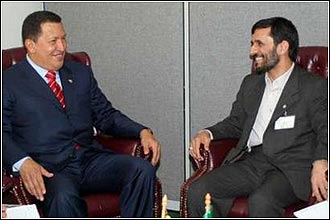
The new best friends on the block. Chavez and Ahmadinejad, Ahmadinejad and Chavez. Chavez is supporting everythig that Ahmadinejad is doing in regards of nuclear research. And he is even trying to makes jokes, or what he thinks it's a joke to get a big laugh from his Iranians friends. Not long ago Ahmadinejad denied the holocaust. Is he just keeping up with Persia's history of denying the holocaust? Could it be that he is counting on Iran's nuclear research to pass it on to them in the future?, ergo to Castro, ergo to anyone who has money to buy it? Otherwise, I have no idea whatsoever on why Chavez is messing up with anti-semitism and internal affairs of other countries instead of fixing the viaduct that keeps incommunicated the valley of Caracas from the airport and the port. The situation has become very bad to the point that people cannot send or receive FedEx from/to Caracas until further notice. It is important to quote that not all Jews believe that Chavez remarks were anti-semitic. Needless to say that I do and so the Simon Wiesenthal Center does as well.
Now the UN wants to give Iranians and angry spanking on the bottom about their trespassings in nuclear research. I can picture Chavez and Ahmadinejad and the rest of the clan (Castro, Morales, Humalla, Zapatero?) smoking havanos and having a big laugh about the possible economic sanctions that the UN might give to Iran. Whooooooo I am so scared of the UN!
Douglas MacKinnon wrote this interesting piece back in May, 2005.
It's fine with me for countries to develop nuclear energy as long it doesn't represent a danger to everybody else. Why nobody believes this is an important matter, or that the Iranians or Venezuelans won't have the balls to do anything bad with nuclear technology? The strongest answer I get is that Iranians are nice people so they won't go fanatic like others... uhmm... yeah right. So Venezuelans and Cubans are very nice too... doesn't make an apology for their currupt governments.
Why two countries loaded with oil want to go nuclear? Here is some compasionate opinions from the understanding people from the 1st world.
Wednesday, January 11, 2006
Bran-gelina is pregnant!!
AWMYGAWDDD Bra-ngelina is having a baby!! Even though I am on the side of Jennifer, I congratulate the pretty couple... wishing many years of happines along with their kids...
LOS ANGELES (AP) — Angelina Jolie is expecting a baby this summer with Brad Pitt, finally affirming the long-presumed relationship previously only glimpsed on African beaches and in paparazzi snapshots.
Pitt's publicist, Cindy Guagenti, told The Associated Press on Wednesday that Jolie is pregnant and that Pitt is the father, confirming People magazine's earlier report.
"Yes, I'm pregnant," the magazine quoted Jolie as telling a charity aid worker Monday in the Dominican Republic, where she is filming "The Good Shepherd" with Matt Damon.
The news comes one month after papers were filed to make Pitt the adoptive father of Jolie's two children. Jolie sought to change the names of the children to Zahara Jolie-Pitt and Maddox Jolie-Pitt.
Pitt accompanied Jolie to Ethiopia in July to pick up Zahara, now 1. Jolie's adopted son, now 4, is from Cambodia.
Jolie's father, Jon Voight, was reached Wednesday morning for his reaction by entertainment TV show "Access Hollywood." The Oscar-winning star of 1978's "Coming Home" said he had not spoken to Jolie, but said, "Angie is my daughter and I am always wishing the best for her."
Previously, Jolie, 30, and Pitt, 42, had not publicly acknowledged their relationship despite increasingly frequent sightings of the couple. They had been spotted together across the globe: in Canadian shopping malls (near Pitt's movie set for "The Assassination of Jesse James by the Coward Robert Ford"), vacationing on African beaches and, most recently, in Pakistan.
In November, Pitt and Jolie, a goodwill ambassador for the U.N., toured quake-devastated areas in Pakistan. Jolie also met with Pakistani President Gen. Pervez Musharraf.
Jolie, whose films include "Lara Croft: Tomb Raider" and "Alexander," is divorced from actors Billy Bob Thornton and Jonny Lee Miller.
Pitt, the star of films including "Ocean's Eleven" and "Troy," had no children from his four-year marriage to Jennifer Aniston, which ended in divorce last October. The couple cited irreconcilable differences. Pitt has denied Jolie was behind the split.
Pitt and Jolie also starred together in "Mr. and Mrs. Smith" last year.